cardaq
•fintech
•transactions
AI in Payments: Transforming Financial Workflows with Teido AI Agents
Payment routing automation is now increasingly possible with technical achievements, helping payment ambitions become reality.
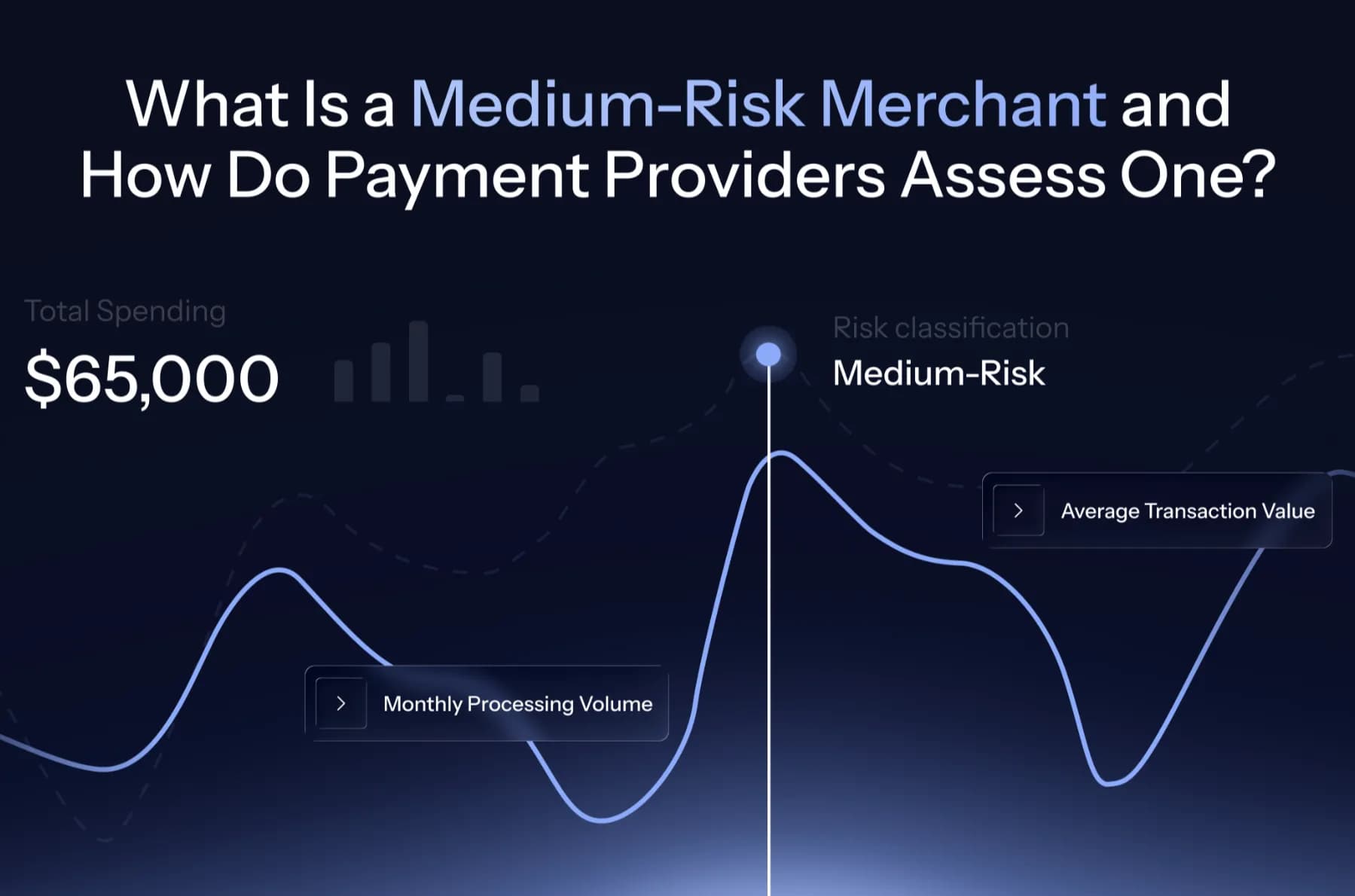
A medium-risk merchant is a business that is neither low risk nor high risk, but has a medium risk profile. The challenge this poses for payment firms is medium-risk merchants can be challenging to service from a risk and security perspective, in determining the appropriate measure of risk management to apply. Risk appetites between different payment providers can also vary, meaning a medium-risk merchant may be accepted by one payment provider but rejected by another. It’s important to understand your business’s risk profile before applying for payment processing, as well as what can be done to potentially help improve chances of approval.
The risks of a medium-risk merchant can originate from a variety of sources — industry, sales model, transaction size, chargeback exposure, refund patterns, international customers, or how long a business has been processing payments. This means medium-risk businesses can often be subscription-based businesses, ticketing companies and online companies with above average order sizes.
Characteristics that can define a medium-risk merchant include:
Higher average transaction value or volume: Larger purchases and notable monthly processing volume can create more financial exposure for banks and processors.
Recurring billing or subscriptions: Subscription models can lead to more billing disputes, cancellations, and chargebacks.
Online or card-not-present sales: E-commerce and remote transactions can carry more fraud risk than in-person payments.
International customer base: Cross-border payments can add fraud, currency, compliance and dispute risks.
Seasonal or inconsistent sales volume: Sudden spikes in payment volume can make processors review accounts more closely.
Limited processing history: Newer businesses may be seen as riskier because processors have less data to review.
Medium-risk merchants don’t typically fit into a specific sector. One online subscription business in the nutraceutical space may be classed as medium-risk, while a competitor could be seen as low or high risk. It will depend on factors such as that specific business’s operating model, processing history, transaction profile, chargeback and refund patterns.
How Do Payment Providers Assess Merchant Risk?
Different payment providers will have their own specific criteria when it comes to assessing the businesses they partner with, but there are general areas that will come up in due diligence.
Business model and products/services. Some formats invite greater risk, such as online businesses which can be more prone to fraud where KYC is harder to verify.
Transaction volume and average transaction value. Payment providers will ascertain what transaction volume and average value can be expected with a specific merchant. Should this differ in reality, further review may be prompted.
Customer geography. Wide-ranging customer bases can increase potential risk exposure for payment providers. A payment provider will want to know which jurisdictions it’s exposed to, and some geographies can pose considerable challenges from the perspective of KYC.
Expected chargeback rates. A business’s rate of chargebacks is an important metric for many payment providers. Average rates can vary depending on the industry, for instance education and training carries the highest average chargeback rate at 1.02%, and restaurants the lowest at 0.12%. The industry a business operates in dictates expectations for the chargeback rates and payment providers will likely take this into consideration.
Refund and cancellation policies. Linked to chargebacks, payment providers will also want to understand how a business deals with refunds and cancellation policies.
Previous payment processing history. Payment providers will analyse merchants’ trading history to understand their historic payment processing patterns. This will help indicate typical customer behaviour, average transaction size and other important metrics.
Company structure and ownership. Providers naturally want to know who they are dealing with and this includes identifying the end owners of a business.
For business owners applying with payment providers, it’s important to be ready for their KYB verification, and KYC and AML checks as part of their merchant risk assessment.
This often starts with ascertaining proof of identity for beneficial owners and directors of the business, so be prepared to provide scans of passports, driving licences and other key documents. Payment providers will also want verification of ownership of the business, such as articles of incorporation, and anything that verifies the business location (utility bills for example). Please note the specific documentation required could vary by payment provider. Payment provider underwriters usually won’t only look at the documentation submitted to them in an application, and will look across other sources (such as websites and brochures). It’s important that this information is consistent across all sources.
Payment providers will also often require records of company accounts, customer records and other information linked to business policies and pricing lists. These will only be available from businesses that have been operating for some time, and startups will need to give as much indication as possible as to what their outlook is. Incomplete information, or delays in submission, may slow down the process. Failure to meet these expectations can result in substantial setbacks and merchant attrition.
Being classified as a medium-risk merchant can mean having to meet additional onboarding steps and monitoring requirements with payment providers. Some payment providers may require settlement conditions and rolling reserves, but these will vary on the individual situation and are not automatic requirements for every medium-risk merchant. A rolling reserve is a percentage of a merchant’s gross sales withheld by a payment provider to cover the cost of chargebacks or refunds over a particular period. The retained funds are released according to the agreed rolling schedule, subject to the provider’s terms and any outstanding liabilities.
It can be beneficial to choose the right payment provider, where there is a healthy alignment in risk appetite. There are high-risk processors that specifically cater for merchants deemed to be high-risk. However these will often bring higher costs and extra requirements with them.
It’s important for businesses to provide payment providers with an accurate, transparent and complete account of their operations. Preparing accurate business documentation and having everything ready to submit is a key part of this, and beneficial owners and directors should be prepared to clearly explain the business model. Payment providers will appreciate a clear, full and frank explanation upfront. This should extend to explaining refund and cancellation policies so providers can get a full idea of how money will be moving.
To help secure good alignment between both parties, merchants should also carry out due diligence of the payment providers they are applying with. This can include researching payment providers with previous experience in their sector or having dealt with similar business models. Merchants should also assess a provider’s pricing, settlement terms, support and contractual requirements.
The medium-risk merchant definition is open to interpretation, and can capture a lot of businesses. This is further complicated by payment providers often bringing their own risk classifications to the table. As covered, there is a great deal that businesses can do to boost their chances of approval, and it’s important to be well prepared before embarking upon this application process.
Cardaq assesses each acquiring application individually and works with eligible low- and medium-risk businesses where there is a good fit.
Get in touch with the team to discuss your business and find out what is possible.
AUTHOR

Cardaq Team
25 September, 2026