payments
•fintech
•trends
How to Choose a Payment Orchestration Platform: A Practical Guide for 2027
Payment orchestration platforms have fast emerged as an important part of many payment processing firms’ tech stacks.
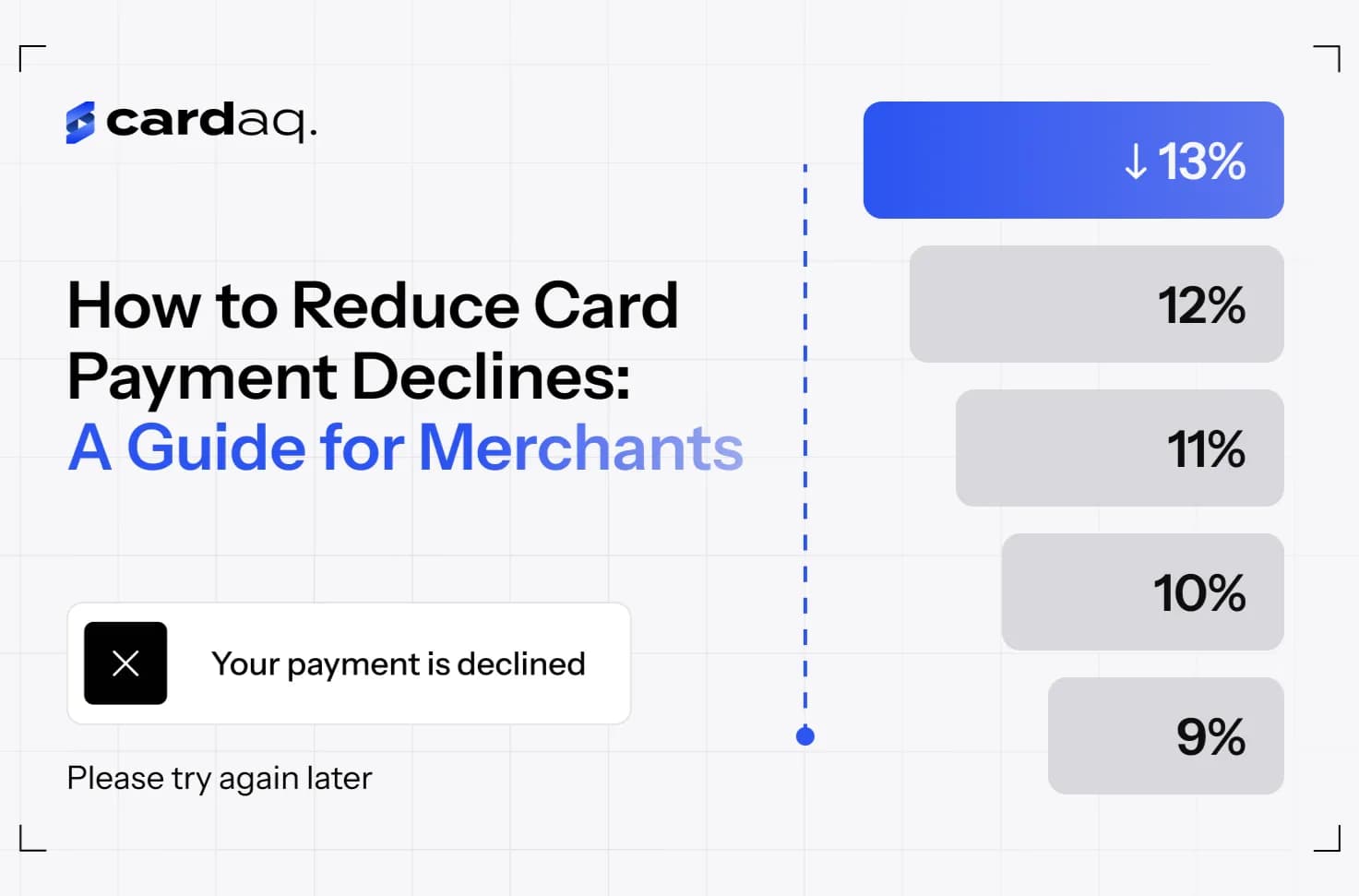
A customer chooses a product, reaches the checkout and enters their card payment details. Then comes the message neither side wants to see: “payment declined”.
For merchants, card payment declines are more than just failed transactions: they can cause serious damage to the customer experience, and turn potential revenue into an abandoned sale.
A declined transaction doesn’t necessarily mean a customer can’t complete their purchase, nor does it always indicate attempted fraud. Some declines are final, while others may be recoverable.
Understanding why transactions fail is fundamental to understanding how to reduce payment declines. For merchants, gaining actionable insights from failed transactions can improve payment acceptance by revealing where declines originate and where action can be taken.
Payment processing involves several parties before an approval reaches the checkout, typically involving the merchant’s payment infrastructure, an acquirer that processes card payments on the merchant’s behalf, a card network and the customer’s issuing bank, or issuer. A transaction can therefore fail at different points and for very different reasons.
Common payment decline reasons include:
Insufficient funds: the customer’s account does not have enough available funds to complete the transaction.
Expired or invalid card details: the card has expired or payment information has been entered incorrectly.
Transaction limits: the payment exceeds a limit imposed by the issuer or cardholder.
Suspected fraud: the issuer or another part of the payment chain identifies the transaction as potentially fraudulent.
Authentication failure: the customer cannot successfully complete an authentication request.
Issuer risk decisions: the issuing bank declines the transaction based on its own risk assessment.
Technical problems: connectivity, processing or configuration issues prevent the payment from completing.
Merchant configuration: payment settings or the way transaction information is submitted can contribute to a decline.
Visa data shows that the three biggest decline reasons globally, by value, are insufficient funds, suspected fraud and exceeding approval amounts (Visa Consulting & Analytics, 2025). Meanwhile, Mastercard estimates 15% of declines are due to technical issues or policy errors (internal Mastercard analysis, 2024).
Understanding the distinctions between declines is crucial: an appropriate response to one decline may be completely inappropriate for another. The first rule of reducing payment declines is therefore simple: diagnose before you retry.
Payment declines are commonly described as either soft or hard.
A hard decline usually indicates a problem that is unlikely to be resolved by simply submitting the same transaction again (such as a lost, stolen, cancelled, expired or invalid card). A soft decline may indicate a temporary issue that could include insufficient funds, a technical problem or the need for additional authentication.
But merchants shouldn’t assume every soft decline should immediately be retried. Knowing when a decline may be recoverable can be aided by issuer response codes (standardised messages returned following an authorisation request) indicating why an authorisation request has been declined.
Card networks and payment processors can use or supplement this information to help merchants understand the appropriate next step, including whether a payment retry may be appropriate. An insufficient funds decline, for example, may warrant another attempt after an appropriate period, whereas a decline indicating a lost or stolen card should not be retried.
For subscription and recurring-payment businesses in particular, intelligent retry logic can be important. But intelligence needs accurate payment data.
Issuers have a very short window in which to make a payment authorisation decision based on payment data available to them.
Too little scrutiny can increase fraud exposure, whereas too much indiscriminate friction can frustrate legitimate customers. Accurate transaction data can help issuers and fraud systems distinguish normal customer behaviour from something genuinely unusual.
A purchase from a long-standing customer using a familiar device presents a different risk profile from the same-value transaction involving a new customer, unfamiliar device and unexpected location. Likewise, correctly identifying an established recurring payment using an existing method on a new device gives an issuer important context about why the transaction is taking place.
Authentication is another part of the equation. In the UK and EEA, Strong Customer Authentication (SCA) is a regulatory requirement for many online card payments, and EMV 3-D Secure (EMV 3DS) is the primary means by which merchants and issuers meet it. EMV 3DS enables information about the transaction, payment method and device to be exchanged to support cardholder authentication. Risk-based assessment can allow lower-risk transactions to proceed through a frictionless flow without additional customer input, while transactions requiring further verification can trigger a challenge, such as asking the customer to verify their identity through their banking app.
Treating all declines as a single figure gives the merchant no visibility on where problems are occurring and how they can be tackled. Broken down properly, they become valuable insights that can improve payment performance.
Merchants should therefore analyse performance by factors including decline reason, issuer response, geography, card type, payment method, device, customer segment, authentication outcome and whether payments are recurring or one-off.
Consider a merchant that sees its overall decline rate suddenly increase. If the rise is predominantly caused by insufficient funds, that presents a very different problem from an increase in suspected-fraud or authentication-related declines. Similarly, if payment acceptance remains strong among UK customers but deteriorates among customers elsewhere in Europe, the merchant has a much more specific area to investigate.
The same applies across the customer journey. Higher authentication failures on mobile than desktop could point towards friction or technical problems in the mobile payment flow. A higher proportion of fraud-related declines among first-time customers than established customers could warrant closer examination of risk rules and false positives.
For a subscription business, meanwhile, recurring payment failures could indicate issues such as expired credentials, which call for account updater services or network tokenisation rather than retries, or temporary insufficient funds, where a well-timed retry within card scheme rules may help.
Once merchants understand the reason for a decline, they can make a better decision about what happens next. Retry logic should respond to the information returned through the payment infrastructure rather than relying on indiscriminate resubmission. For subscription businesses in particular, the aim is not more retries, but better-timed, better-informed ones.
Retry strategies must also follow card scheme rules. Visa and Mastercard limit how many times, and over what period, a declined transaction can be reattempted, and excessive or non-compliant retries can carry scheme fees. Some decline responses should never be retried at all.
Expired or reissued cards are a different case: they are recovered through account updater services or network tokenisation, not retries. Network tokenisation replaces the card number with a scheme-issued token that is updated automatically when a card is reissued, helping stored credentials stay current while reducing the exposure of sensitive card data.
Clear customer communication is paramount. Where appropriate, giving a customer an opportunity to update an expired card, provide corrected information, complete authentication or choose another payment method may offer a better route to recovering a sale.
It’s tempting to treat payment acceptance as a checkout optimisation problem. But behind the checkout sits a much larger infrastructure, including gateways, acquirers, issuers, card networks, authentication tools, fraud systems, transaction monitoring, routing and reporting.
The interaction between those components can affect whether a legitimate transaction ultimately succeeds.
Payment routing (determining which processing route a transaction takes) can also become relevant, particularly for merchants operating across multiple markets. The appropriate setup will depend on a merchant’s business model, geography and payment architecture, but the broader point remains: payment performance needs to be examined end to end.
Improving payment acceptance requires metrics that help merchants identify where transactions are failing and, crucially, what they can change as a result. Useful metrics can include:
authorisation rate;
overall decline rate;
false decline rate;
soft versus hard declines;
retry success rate;
overall payment success rate;
declines by geography, issuer and card type; and
recurring payment failure rate.
Tracked together, these metrics show merchants what to change. If the authorisation rate falls after a merchant changes its fraud rules, the merchant can compare performance before and after the change. Refining broad fraud rules could reduce false declines without weakening fraud protection.
If recurring payments are failing because stored cards have expired or been replaced, account updater services or network tokenisation can keep stored credentials current and prevent some failures without any need to retry. Changes to routing, acquiring arrangements or the payment methods offered could also potentially improve performance.
To learn more about Cardaq’s acquiring solutions, visit cardaq.com.
Visa Consulting & Analytics, “Helping to maximize merchant success through authorization and fraud prevention”, 2025 (global VisaNet data, April 2023 to March 2025): https://corporate.visa.com/en/services/visa-consulting-analytics/insights/vca-maximize-merchant-success.html
Mastercard, “Mastercard Early Detect Insights” (citing internal Mastercard analysis, 2024): https://www.mastercard.com/gb/en/business/insights-intelligence/operations-intelligence/solutions/mastercard-early-detect-insights.html
Cardaq provides card acquiring services to eligible low- and medium-risk merchants, supporting secure and reliable payment acceptance.
Cardaq Limited is authorised by the Financial Conduct Authority as an Electronic Money Institution (FRN 900088).
AUTHOR

Cardaq Team
30 October, 2026