payments
•fintech
•trends
How to Choose a Payment Orchestration Platform: A Practical Guide for 2027
Payment orchestration platforms have fast emerged as an important part of many payment processing firms’ tech stacks.
For merchants, processing a payment doesn’t always mean having immediate access to the money.
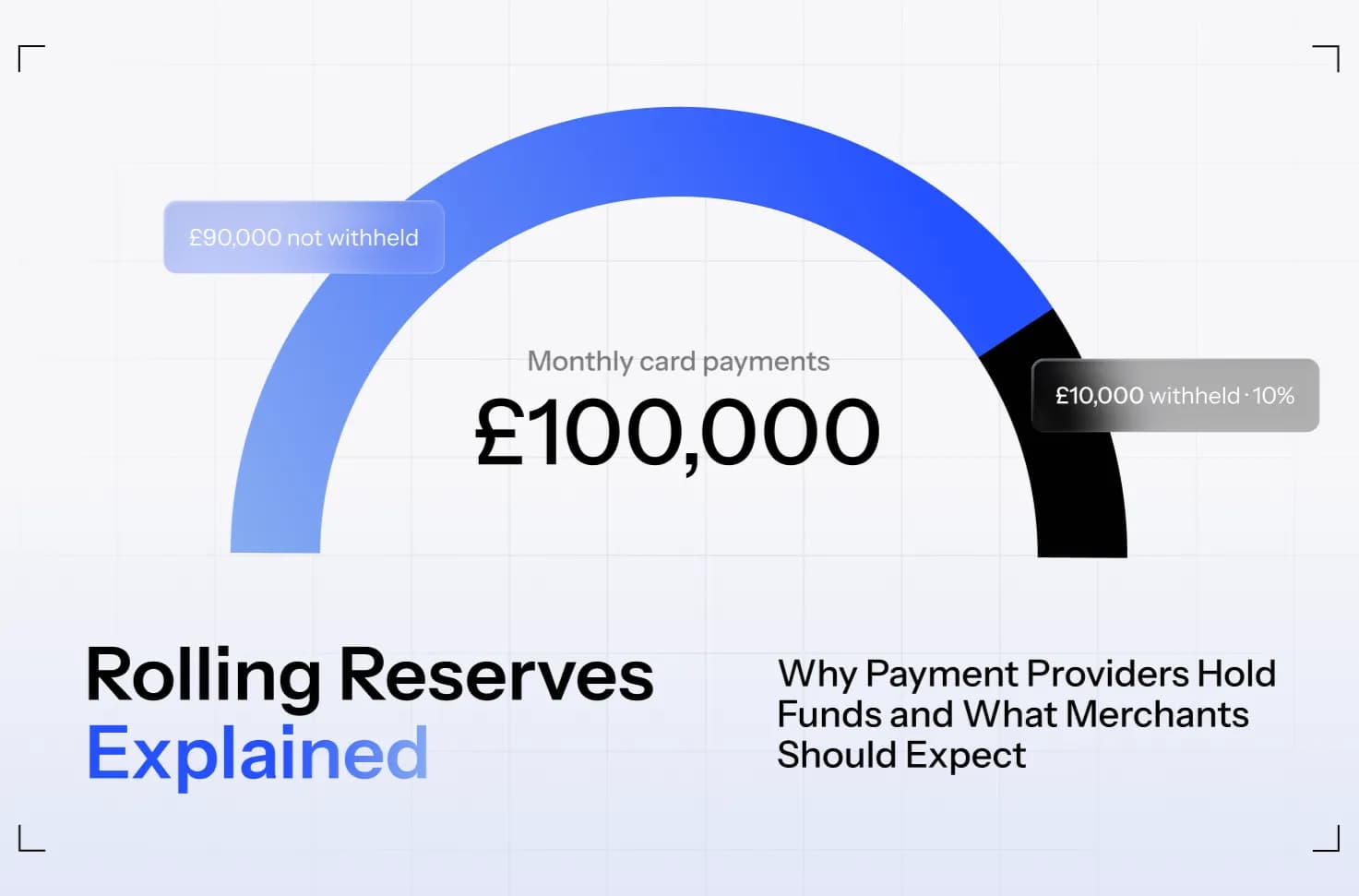
Imagine a business processing £100,000 in card payments, only to find that £10,000 is being withheld by its payment provider as a financial safeguard.
This is known as a rolling reserve. It’s not necessarily a warning sign about the business, but it can put significant pressure on cash flow if merchants aren’t prepared. Understanding how reserves work, why they’re applied and when funds may be released is essential to effective financial planning.
A rolling reserve is an established way for payment providers to manage financial exposure. Typically, a merchant’s payment provider or acquirer temporarily withholds an agreed percentage of the merchant’s processed card payments for a specified period.
The money provides protection against potential liabilities, including chargebacks (payments disputed through a customer’s bank), refunds and other payment-related losses. Unlike a processing fee, reserve funds are generally scheduled for release after the agreed holding period, subject to the provider’s terms and any outstanding liabilities.
A merchant account reserve might involve retaining a percentage of transactions for several months or an agreed time frame, with funds progressively released back into the merchant’s account as each holding period expires.
The percentage, duration and release conditions vary according to the agreement and the provider’s assessment of merchant risk: the potential financial exposure associated with processing a business’s payments.
Payment processing creates financial obligations that can extend beyond the original transaction.
For instance, a customer might dispute a payment weeks or months after purchasing a product. A merchant may need to issue refunds following cancellations, or a business could encounter fulfilment problems after receiving payment for goods that haven't yet been delivered.
These situations create potential exposure for the payment provider or acquirer (the financial institution or service provider enabling the merchant to accept card payments). Rolling reserves provide a financial buffer against those liabilities, particularly where the merchant’s available balance may be insufficient to cover them.
Importantly, no single factor automatically means a merchant will face a reserve. Providers typically consider processing history, chargeback and refund levels, business model, transaction volumes, industry and international exposure.
For example, a business accepting advance payments for services delivered months later may present a different risk profile from a retailer fulfilling orders immediately.
Rolling reserve payment processing involves three principal elements: the percentage withheld, the holding period and the reserve release schedule.
Consider our hypothetical merchant processing £100,000 in card payments each month, with a 10% rolling reserve held for 90 days. For simplicity, assume the reserve is calculated on the full processed amount, before fees, refunds and other adjustments.
Rolling reserve percentage 10%
Funds withheld that month £10,000
Funds not withheld by the reserve £90,000
Holding period 90 days
The £10,000 isn’t a fee. It’s withheld for the agreed period, after which it’s scheduled for release, subject to the applicable terms. Meanwhile, new transactions continue generating additional reserve funds. Once the arrangement reaches its regular cycle, older amounts are released as newer amounts are withheld.
Assuming three monthly deductions of £10,000 before the first release, the reserve balance could reach approximately £30,000. In practice, the balance will depend on transaction dates, the provider's calculation method and the precise release schedule.
An important distinction is that settlement and reserve release are separate events. Settlement is the regular payout of transaction proceeds to the merchant. Reserve release concerns previously withheld amounts becoming available to the merchant under the provider's agreed terms.
Not every restriction on merchant funds is a rolling reserve.
A temporary payment hold may restrict access to particular funds while a transaction or account issue is reviewed.
A settlement delay means payment proceeds become available later than usual, without necessarily creating a separate reserve balance.
A fixed or upfront reserve may require a specified amount to be maintained, rather than withholding a percentage of each transaction for an individual rolling period.
A capped reserve means a percentage is withheld until a set ceiling is reached.
A chargeback-related hold may be linked to actual or anticipated dispute liabilities.
These arrangements can have different triggers, durations and release conditions. Merchants should establish precisely which mechanism applies.
Rolling reserves can arise across different merchant categories, depending on the provider’s risk assessment.
New businesses may have limited processing histories. Subscription companies can face recurring billing disputes or cancellation-related refunds. Businesses accepting payments well before delivery may have obligations extending beyond the original sale.
Rapid growth, unusually high transaction volumes or expansion into international markets may also change a merchant’s risk profile.
None of these characteristics automatically results in a payment processing reserve. They illustrate why providers assess the relationship between transaction activity and potential future liabilities.
The biggest practical challenge is the difference between revenue processed and cash available.
Returning to our hypothetical £100,000-a-month merchant, a 10% reserve means £10,000 is withheld each month. During the initial holding period, those deductions accumulate before scheduled releases begin.
That money cannot immediately fund stock purchases, supplier invoices, payroll or expansion.
For businesses operating on narrow margins, the impact on merchant working capital (the resources available to meet day-to-day financial obligations) can be significant. The effect can become particularly important during rapid growth. Higher sales volumes may increase the amount withheld just as the business needs more cash for inventory and fulfilment.
This makes rolling reserve cash flow planning essential. Merchants should forecast available funds after reserve deductions, processing fees, refunds and other adjustments, rather than relying solely on sales figures. Reserves are also often held for a period after the processing relationship ends.
Before accepting a merchant reserve, businesses should understand the commercial and operational terms.
Key questions include:
What percentage of funds will be withheld, and how is it calculated?
How long will each amount remain in reserve?
When and how will reserve funds be released?
Can the provider increase, reduce or remove the reserve?
How are refunds, chargebacks and other liabilities treated?
What happens to outstanding funds if the processing relationship ends?
Will reporting show amounts withheld, released and remaining?
Understanding these rolling reserve agreement terms helps businesses assess the financial implications before committing to a payment provider.
A rolling reserve may be outside a merchant’s immediate control, but its financial impact can be managed.
Forecast available cash: Incorporate reserve deductions and expected releases into financial projections, particularly during the initial accumulation period.
Maintain sufficient working capital: Ensure essential commitments can be met without relying on withheld funds.
Monitor chargebacks and refunds: Investigate dispute patterns, customer complaints and operational problems that may influence a provider's assessment of payment risk.
Keep accurate transaction records: Reliable delivery, refund and payment information can help demonstrate how the business manages its obligations.
Review reserve terms: Understand whether periodic reassessment is possible and what evidence may support a review.
The objective isn’t to assume every reserve can be eliminated. It’s to understand the arrangement, manage the cash flow exposure and maintain a clear picture of available funds.
Rolling reserves serve a legitimate purpose within payment risk management. But their financial implications can extend well beyond the original transaction.
For merchants, the priority is understanding how much money is withheld, when it may be released and how the arrangement affects everyday operations.
Rolling reserves are one of several terms merchants should understand when reviewing a card acquiring agreement. Cardaq provides card acquiring services to eligible merchants and assesses each application against its risk appetite, underwriting criteria and applicable regulatory requirements. To find out more, visit cardaq.com.
Cardaq Limited is authorised by the Financial Conduct Authority as an Electronic Money Institution (FRN 900088).
AUTHOR

Cardaq Team
09 November, 2026