payments
•fintech
•trends
How to Choose a Payment Orchestration Platform: A Practical Guide for 2027
Payment orchestration platforms have fast emerged as an important part of many payment processing firms’ tech stacks.
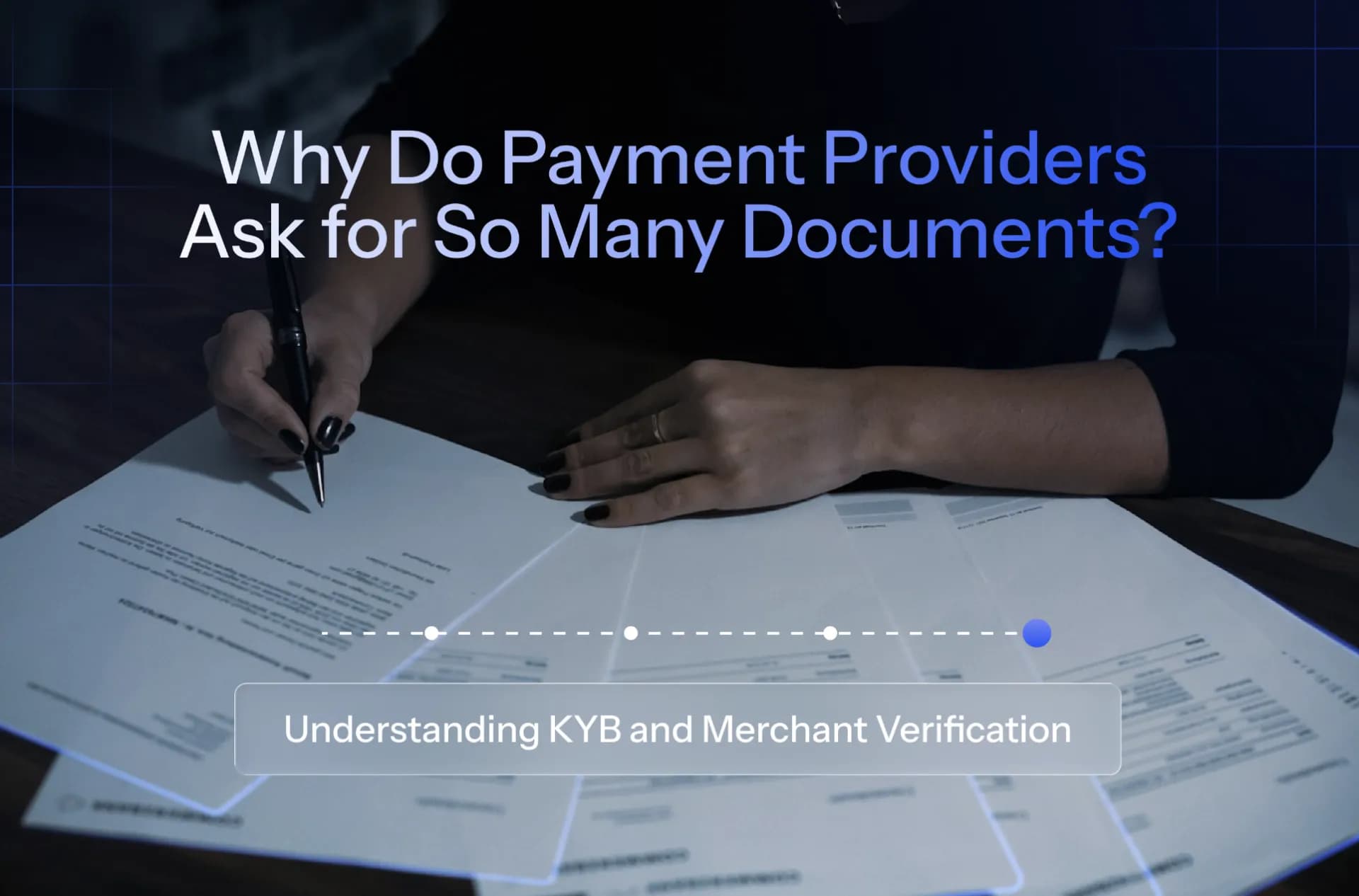
You’ve registered your business, built your website and applied for a merchant account. Then comes the paperwork.
Your payment provider wants company registration details, proof of address, identification documents and information about the people who own the business. Just when you think you’ve supplied everything, another request arrives.
It’s a familiar experience across financial services. Research published by regulatory technology provider Kyckr in September 2026 found that 91% of the 403 UK business decision-makers surveyed had been asked for additional documents or information at least once after applying for a business banking product in the previous two years.
For merchants eager to start accepting payments, it can feel like one unnecessary obstacle after another. But payment provider verification serves an important purpose: establishing who a business is, who controls it and whether its activities present financial or regulatory risks.
Understanding why these checks exist can help merchants prepare more effectively and reduce avoidable onboarding delays.
What Is KYB?
Know Your Business (KYB) is the process of verifying a company’s identity, ownership and activities when establishing and maintaining a business relationship.
It’s closely related to the Know Your Customer (KYC) process, but the two aren’t identical. KYC generally refers to identifying and verifying customers, whether individuals or businesses, while KYB is commonly used for checks on business customers. In practice, KYB checks often include KYC checks on the people behind a business, such as its directors and beneficial owners.
For payment providers, KYB for merchants can involve checking company registration details, identifying owners and directors, understanding what the business sells and assessing how it intends to process payments.
These KYB checks form part of customer due diligence: the measures firms use, under anti-money laundering (AML) rules, to establish and verify customer information and assess financial crime risks.
According to the UK’s Companies House, 26,797 suspicious company filings were prevented from reaching the UK register in the 2025/2026 financial year, illustrating the importance of verifying business information. But merchant verification is about more than confirming that a company exists.
Payment providers operate within a financial ecosystem exposed to fraud, money laundering, sanctions breaches and other risks. Depending on their activities and regulatory status, they must meet applicable financial crime and compliance obligations, which can differ between providers and from country to country.
In the UK, the Money Laundering Regulations require businesses within their scope to apply risk-based customer due diligence, including relevant identity and beneficial ownership checks.
AML controls help prevent financial services from being used to disguise proceeds of crime. Sanctions screening serves a separate purpose: identifying whether a business or relevant individual is subject to financial restrictions.
Providers will also typically check whether directors or beneficial owners are politically exposed persons (PEPs), as prominent public roles can carry a higher risk of bribery or corruption.
Payment providers may also need to satisfy applicable payment network requirements and their own merchant risk policies.
Consider a company applying to process international subscription payments. The provider may need to understand where its customers are located, how recurring billing works, what services are sold and who ultimately controls the business.
These questions support merchant risk assessment and help establish whether the proposed payment activity is consistent with the provider’s understanding of the business.
Common merchant verification document requests can include:
Company registration details: A certificate of incorporation, company number or other evidence that the business legally exists.
Proof of business address: Documents confirming the company’s registered or operating address.
Identity documents: Accepted identification for relevant directors, owners or authorised representatives.
Ownership information: Shareholder records or ownership charts identifying individuals who ultimately own or control the business.
Bank account information: Evidence of the settlement account associated with the merchant’s payment arrangements.
Website and business details: Product descriptions, refund policies, terms and conditions, and fulfilment information.
Relevant licences: Evidence of authorisation where the business operates in a regulated activity.
Business verification requirements vary according to the provider, jurisdiction, business model and information available from reliable sources. Providers may also request contracts, invoices, financial information or expected transaction volumes.
A straightforward UK company with a simple ownership structure may require different documentation from an international business owned through several corporate entities.
An Ultimate Beneficial Owner (UBO) is an individual who ultimately owns or controls a business, including where ownership is held indirectly through other companies.
Imagine a UK merchant owned by a holding company, which is itself owned by two individuals. Checking the merchant’s registration details alone may not establish who ultimately controls it. This is why business ownership verification can involve examining several layers of a corporate structure.
Under the UK Money Laundering Regulations, the beneficial owners of a corporate customer can include individuals who ultimately own or control more than 25% of shares or voting rights, or who exercise control through other means, such as ultimate control over management, the right to appoint or remove a majority of the board, or significant influence or control.
That threshold isn’t a universal test for every entity or regulatory purpose. Beneficial owner verification must reflect the relevant rules and circumstances.
For merchants, accurate shareholder records and a clear explanation of the ownership structure can make these checks more straightforward.
A common misconception is that merchant onboarding verification ends when an account is approved. In practice, due diligence and risk monitoring can continue throughout the business relationship.
A provider may request updated information following changes in ownership, business activity, transaction volumes or geographic exposure. Unusual payment patterns or inconsistencies between the merchant’s stated activities and actual transactions may also prompt further questions.
Some requests arise from periodic reviews intended to keep customer records accurate.
For example, a UK software company initially processing domestic subscription payments might later expand into several overseas markets. Its provider may need updated information about customers, payment activity and geographic exposure.
An additional document request doesn’t necessarily mean the merchant has done anything wrong. Providers may not always be able to explain the reason for a request, particularly where it relates to financial crime controls. It may reflect changing circumstances or the need to refresh existing information.
The extent of merchant due diligence can vary according to the risks associated with a business relationship. Providers may consider industry, geography, transaction volumes, ownership complexity and operating model.
A business with multiple international subsidiaries may need additional ownership documentation. A marketplace handling payments involving several parties may need to explain its transaction flows. A newly established merchant may have limited financial or processing history.
Higher-risk relationships, including those involving PEPs, may require enhanced due diligence: additional checks proportionate to the risks identified. However, additional verification isn’t automatically evidence of wrongdoing, and merchants in the same industry won’t necessarily face identical requirements.
Good preparation won’t guarantee merchant account approval, but it can help businesses avoid missing documents, inconsistent information and unnecessary delays.
Keep company records accurate: Check that registration details, addresses and director information are current and consistent with official records.
Understand your ownership structure: Be ready to identify beneficial owners and explain holding companies or indirect ownership arrangements.
Prepare identification documents: Ensure documents for relevant directors, owners and authorised representatives are valid and meet the provider’s requirements.
Make your business model clear: Your website and application should accurately explain what you sell, where you operate, how customers pay and how goods or services are delivered.
Keep supporting information available: Relevant licences, contracts, invoices and bank account details may be requested as part of payment provider onboarding.
Respond carefully to requests: Missing documents or contradictory information can generate further questions. If a request is unclear, ask what evidence is needed and use the provider’s approved, secure submission channels.
Getting payment-ready involves more than choosing a payment provider. Understanding verification requirements, preparing the right documentation and keeping business information up to date are all part of building a reliable payments operation.
Far from being a tick-box exercise, merchant account verification supports financial crime controls, responsible payment processing and a clearer understanding of the businesses operating within the payments ecosystem.
For merchants, understanding KYB means fewer surprises during onboarding and a clearer idea of what information their payment provider may need as the business evolves.
Cardaq provides card acquiring services and assesses each application against its risk appetite, underwriting criteria and applicable regulatory requirements. Contact the team to discuss eligibility and the information your application may need.
Cardaq Limited is authorised by the FCA as an Electronic Money Institution (FRN 900088).
AUTHOR

Cardaq Team
04 November, 2026