payments
•fintech
•trends
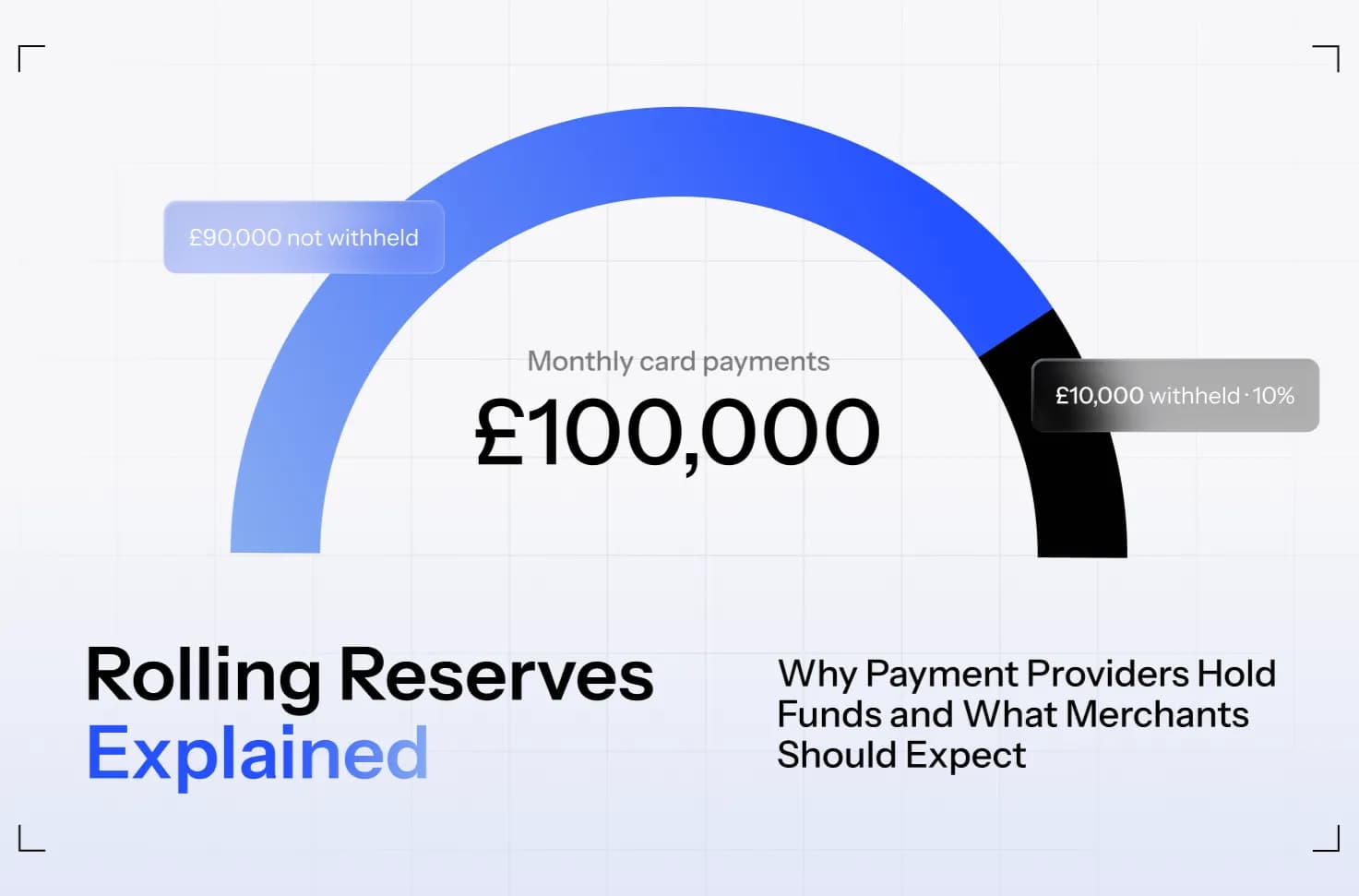
Rolling Reserves Explained: Why Payment Providers Hold Funds and What Merchants Should Expect
For merchants, processing a payment doesn’t always mean having immediate access to the money.
Payment orchestration platforms have fast emerged as an important part of many payment processing firms’ tech stacks. The right orchestration platform can take a firm’s payment solutions to the next level, allowing it to unlock new growth through broader connectivity. Instead of building and maintaining separate connections for every payment gateway or processor, a business plugs into one orchestration layer. This layer acts like a smart control centre for all digital transactions.
This is about bringing harmony to the chaos. In the same way a conductor will help an orchestra play beautiful music, a payment orchestration platform will coordinate multiple networks, entities and parties to enable better speed, choice and transparency when it comes to transactions. This is essential in two ways. First, simply due to the way the world’s payment landscape has evolved with countless entities, networks and payment methods now co-existing. And second, soaring competition means payment service providers (PSPs) can no longer afford to approach markets in a piecemeal fashion. The multi-PSP setup is increasingly common.
However, knowing how to choose a payment orchestration platform is easier said than done. There’s a growing number of payment orchestration platforms for PSPs to choose from. Navigating these options can be difficult, which is why we have compiled this helpful guide.
To work well, a payment orchestration platform must pass every single test thrown at it by a PSP and its requirements. Each PSP will have its own, bespoke needs and these will be based on geography, networks and underlying clients with the latter having their own particular payment demands. This isn’t just about picking a solution based on uptime, but making sure the chosen payment orchestration platform has the resilience and intelligence required of it.
A core part of any payment orchestration platform is the technology engine powering it. Smart routing is a core function of any platform: configurable rules identify the best route for any given payment, with automatic failover if a processor or network underperforms. This also allows for continuous improvement. Errors are flagged, behaviours identified and this data is fed back into future routing decisions, which help the platform to improve how it supports users. Some platforms also apply machine learning to areas such as fraud detection and decision support, but AI-driven orchestration remains an emerging capability rather than an industry standard. Understanding how a platform’s routing and decisioning logic works, and how much control you retain over it, is therefore an important starting point.
It’s also vital to ascertain how independent the platform is, which will help avoid potential biases that would lead it to prioritise certain networks and entities over others. Therefore, ensure the platform is processor-independent. You should also understand who controls the token vault and transaction data. If a vendor makes token migration difficult, you are facing a significant vendor lock-in risk.
And then there are the technical aspects. Look closely at the quality of the platform’s APIs and documentation, as well as its support for webhooks, idempotency, secure authentication, sandbox testing and integration tooling. Depending on the use case, ISO 20022 readiness may also be relevant, particularly for certain banking and institutional integrations. Payment orchestration platforms should also be able to satisfy ongoing analytics and reconciliation requirements, rather than relying only on static reports. The right platform provides transaction-level reporting and settlement data that support effective reconciliation across processors and financial records.
Ultimately, we believe three selection criteria are particularly important for any PSP when conducting payment orchestration platform comparisons:
Intelligent Routing and Decisioning: Configurable routing rules, automatic failover and performance optimisation across processors and networks, supported by machine learning-assisted decisioning where available. Strong API integration is crucial here.
Financial Integrity and Auditability: Ensuring transaction data is accurate, traceable and reconcilable. Where a platform maintains balances or financial state, a robust ledger is essential. In every case, this is not an optional add-on but a core requirement for a clear audit trail.
Data Ownership and Portability: Reducing vendor lock-in by ensuring the business retains full access to its transaction data, has clear migration options and understands the exit arrangements. This helps ensure that the business, not the provider, controls its financial data.
As mentioned, there are a growing number of payment orchestration platforms available and developers have identified more than one way to shape these. To help, here’s a simplified breakdown of how payment orchestration platforms can be grouped:
Model Type | Control Level | Data Ownership | AI-Readiness | Core Database |
|---|---|---|---|---|
Pure-Play | Medium (Abstraction) | Fragmented | Varies | Relational (CRUD) |
Unified | Low (Lock-in) | Restricted | Medium (Closed) | Proprietary |
Infrastructure-First | High | Full | Native (Event-Driven) | Event-Sourced |
A key point of comparison is to understand the way in which these platform models store data differently. Stacked up, Pure-Play platforms, which can have fragmented data ownership, may be lacking in certain areas. Such platforms typically rely on CRUD, which stands for create, read, update and delete. While this approach works for basic dashboarding, CRUD can fall short when attempting to satisfy continuous and multi-layered demands. Different platforms use different approaches to storing and managing transaction data. From a buyer’s perspective, the key consideration is whether the platform provides complete transaction history, traceability, reliable reconciliation and a clear audit trail. Infrastructure-first architectures can also provide a foundation for more advanced event-driven or event-sourced models, supporting greater financial state transparency as these capabilities evolve. Looking ahead, infrastructure-first architectures can also provide the foundation for closer integration between issuing, acquiring and treasury, allowing more of the financial state to be managed through a common infrastructure layer.
Making this kind of selection is not easy.
It’s clear why so many PSPs end up attempting to build their own payment orchestration platform, rather than buy one. The advantages are clear: the PSP avoids selection challenges and can create something truly bespoke to them. However, building a payment orchestration platform is not easy and requires considerable resources in terms of talent and funding. Most PSPs have enough to focus on with their core business, and don’t have the spare time, resources or investment to reallocate developing a platform. Additionally, the time taken to create a viable platform in-house could also put a PSP behind its competitors.
Buying the use of a premade payment orchestration platform is often the more practical choice for a PSP. This decision needs to be approached carefully as, aside from all the technical considerations to go over, due diligence has to be thorough, looking past the glossy sales patter and getting to grips with the realities of the software.
This is about avoiding various pitfalls, which include:
Pooled balances without a full ledger: Where pooled or omnibus balances are used, buyers should verify that the provider maintains sufficiently granular records to attribute balances, transactions and adjustments correctly and to support reliable reconciliation and audit.
Limited token portability: This is the use of overly rigid and inflexible guardrails that make the export of payment tokens to another provider difficult or costly.
Unclear treatment of client funds: If a vendor cannot clearly explain how client balances are recorded, safeguarded and reconciled, they may lack the domain maturity to withstand audits.
Hidden Processing Fees: Beware of percentage-based fees layered on top of PSP costs, which can often include setup costs, implementation fees and monthly minimums. Look for providers that offer transparent SaaS or infrastructure-based pricing.
We appreciate it can still be confusing to navigate the (rapidly growing) world of payment orchestration platforms, so here’s a simple list of functionality features to check:
Token Portability: Establish who controls the payment tokens, whether they can be migrated between processors and what contractual or technical restrictions apply.
Reporting and Reconciliation: Transaction-level reporting and settlement data that reconcile cleanly across processors and your own financial records.
Fraud and Risk Controls: Assess the platform’s native fraud and risk capabilities, as well as its ability to integrate specialist third-party services into the transaction flow. More advanced integration of transaction, risk and compliance data can support increasingly automated decisioning as these capabilities evolve.
AI and Advanced Analytics (where available): Treat these as optional rather than core requirements. Where a platform uses AI, check how decisions are made, whether they can be explained and what human oversight is in place.
Payment infrastructure evaluation is a challenging but necessary step for PSPs and, if done right, can help unlock new opportunities in the modern payments landscape.
Payments are now much more complex than just a means of executing transactions. Done right, payments can deliver a huge amount of value to an organisation by helping them access new suppliers and customers around the world as well as better transact with existing ones. This requires the right infrastructure though and PSPs need to have payment orchestration platforms that can support their ambitions and unlock new levels of choice, transparency and speed.
As such, picking the right payment orchestration platform is crucial. These are all being developed to cater for the rapidly expanding world of modern payments but, as we’ve covered, there are various nuances between these to understand. The emphasis here is on due diligence and developing a full understanding of how a potential payment orchestration platform can support a PSP, now and in the future.
Cardaq provides card acquiring, card issuing and payment account services for eligible businesses. Contact the team to discuss your payment infrastructure requirements.
Cardaq Limited is authorised by the FCA as an Electronic Money Institution (FRN 900088).
AUTHOR

Cardaq Team
13 November, 2026